

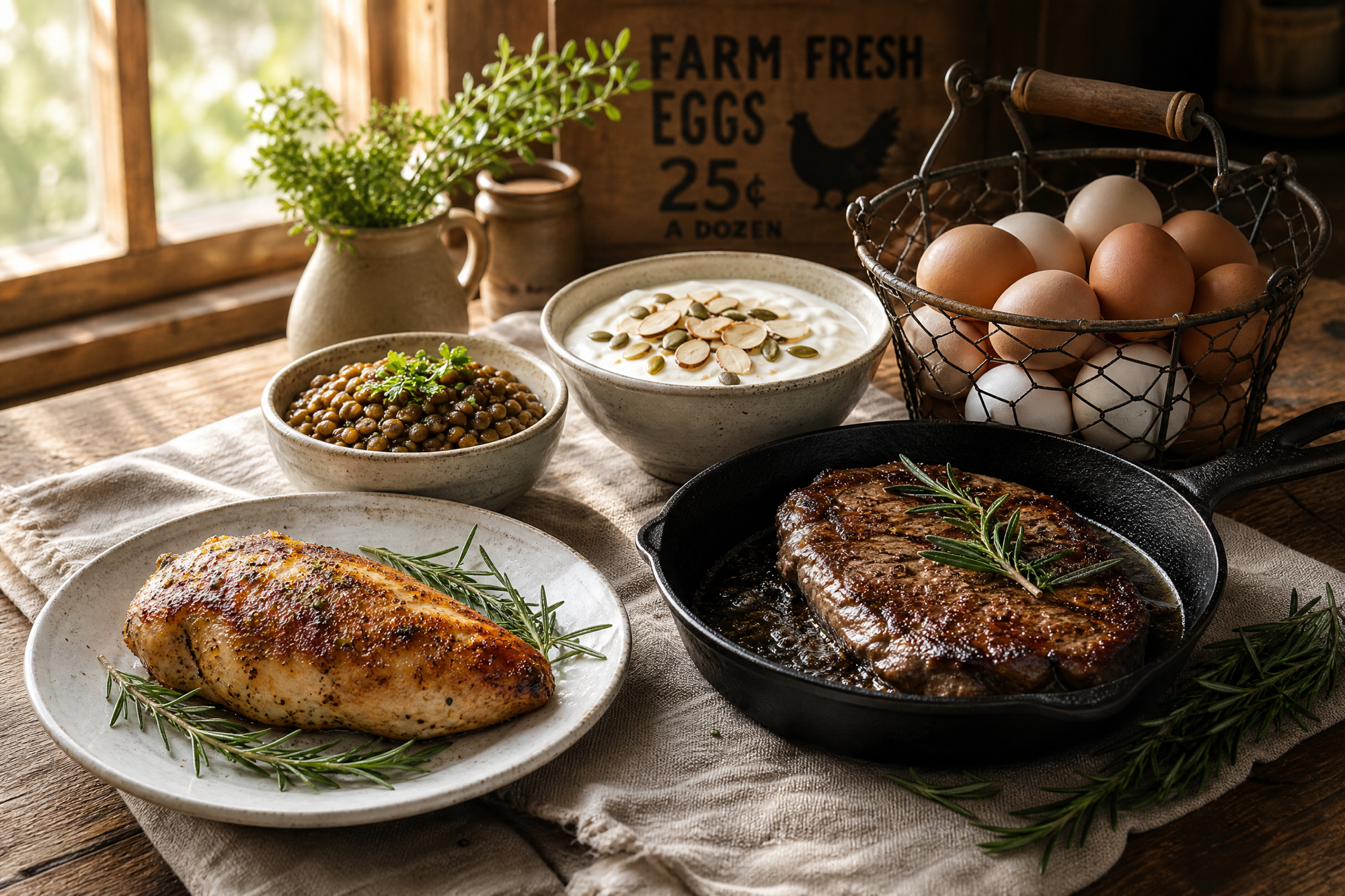
If you want to build muscle, lose fat, or simply recover better from training, the fastest lever you can pull isn't your workout — it's your protein intake. Most active adults are eating far less protein than their body actually needs, and that gap is quietly stalling results in the gym and in the kitchen.
The short answer: the best high-protein foods are chicken breast, turkey breast, lean beef, salmon, tuna, eggs, Greek yogurt, cottage cheese, and for plant-based eaters tempeh, tofu, edamame, and lentils. Active adults should aim for roughly 0.7–1.0 grams of protein per pound of bodyweight daily, spread across 3–4 meals of 20–40 grams each.
At Virtuous Gym, we coach members all across Silverdale WA through exactly this problem every week. This guide breaks down the research, the best food sources, and how to actually apply it — plus a free downloadable PDF you can save and use at the grocery store.
Why Protein Matters More Than Almost Anything Else in Your Diet
Protein is the raw material your body uses to repair muscle tissue, produce hormones, support your immune system, and keep you full between meals. Of the three macronutrients, it has the strongest and most consistent research behind it for improving body composition — especially for people who train regularly.
The International Society of Sports Nutrition's position stand on protein and exercise is clear: active individuals need meaningfully more protein than the general RDA (which sits around 0.36 grams per pound of bodyweight) to support training adaptations, preserve lean muscle, and recover well — particularly when eating in a calorie deficit to lose fat.
This matters whether you're a former college athlete easing back into training, a firefighter needing to stay strong on shift, or a parent trying to keep up with your kids. Protein isn't just a "bodybuilder" macro. It's foundational.
How Much Protein Do You Actually Need?
Here's where most people get it wrong — they either wildly overestimate how hard this is, or they underestimate how far off their current intake actually is.
General target for active adults: 0.7–1.0 grams of protein per pound of bodyweight per day.
For a 170-pound adult training 3–5 days per week, that lands between 120–170 grams of protein daily — spread across the day rather than saved for one big meal.
A few more research-backed numbers worth knowing:
- 20–40 grams per meal is the sweet spot for maximizing muscle protein synthesis (the process that actually builds and repairs muscle).
- 2.5–3 grams of leucine per meal is the trigger amount needed to kick that process into gear. Leucine is an amino acid found in high concentrations in animal proteins and soy.
- Every 3–4 hours is roughly how often you want to feed your body protein to keep this process elevated throughout the day, rather than spiking once at dinner.
If you've never actually tracked your protein for a few days, it's worth doing — most people are surprised by how far under target they are.
The Best Animal-Based High-Protein Foods
Animal proteins are considered "complete" proteins — meaning they contain all nine essential amino acids your body can't produce on its own — and tend to have higher digestibility than most plant sources. That makes them a highly efficient way to hit your daily target without excess calories.
| Food | Protein (per 100g) | Why it's a top pick |
|---|---|---|
| Chicken breast | 31g | The leanest, most versatile source; complete amino acid profile |
| Turkey breast | 30g | Best protein-to-calorie ratio of any poultry |
| Tuna (canned, water) | 29–30g | Shelf-stable, cheap, nearly zero fat |
| Chicken thighs (skinless) | 26g | More flavor and satiety than breast for a small calorie cost |
| Lean ground beef (93/7) | 26g | Rich in iron, B12, creatine, and zinc |
| Eye of round / lean beef | 27–28g | The leanest whole-cut beef option |
| Ground chicken (93% lean) | 24g | Budget-friendly and versatile for meal prep |
| Salmon | 20–25g | Adds anti-inflammatory omega-3 fatty acids |
| Canned sardines | 25g | Omega-3s plus calcium from the edible bones |
| Shrimp | 24g | Highest protein-to-calorie ratio of any seafood |
| Cottage cheese | 11–13g | Mostly casein — a slow-digesting protein, great before bed |
| Greek yogurt (plain) | 9–10g | Casein protein plus gut-friendly probiotics |
| Eggs (whole) | 13g | Biological value near 100 — your body uses nearly all of it |
| Egg whites | 11g | All the protein with almost none of the fat or calories |
| Whey protein powder | 70–90g | Fastest-digesting protein; ideal immediately post-workout |
Values are approximate per 100g, cooked, based on USDA FoodData Central figures.
The Best Plant-Based High-Protein Foods
Plant-based proteins bring fiber, micronutrients, and phytochemicals that animal sources simply don't offer — but most (with the exception of soy) are "incomplete," meaning they're missing one or more essential amino acids. Pairing a legume with a grain over the course of your day (rice + lentils, hummus + pita) closes that gap.
| Food | Protein (per 100g) | Why it's a top pick |
|---|---|---|
| Seitan | 25g | Made from wheat gluten; extremely protein-dense |
| Tempeh | 19g | Fermented — easier to digest and more bioavailable |
| Pumpkin seeds | 19g | Protein-dense, but also calorie-dense, so portion it |
| Peanuts | 26g | Cheap, accessible, and rich in healthy fats |
| Edamame | 11g | A rare complete plant protein — it's young soybeans |
| Lentils (cooked) | 9g | 18g protein and 16g fiber per cooked cup |
| Chickpeas (cooked) | 9g | Versatile; pairs well with grains for a complete profile |
| Tofu (firm) | 8g | Absorbs flavor well; complete amino acid profile |
| Quinoa (cooked) | 4.4g | One of the only grains that's a complete protein on its own |
Values are approximate per 100g, cooked, based on USDA FoodData Central figures.
How to Actually Hit Your Protein Target Every Day
Knowing the numbers is one thing. Building a routine around them is another. Here's the framework we give our coaching clients:
1. Anchor every meal with a protein source. Don't leave protein as an afterthought. Decide what your protein source is first, then build the rest of the meal around it.
2. Don't fear the fat on animal protein. Chicken thighs, salmon, and 93/7 ground beef aren't "worse" than the leanest cuts — the extra fat often makes meals more satisfying, which helps you stick to your plan long-term.
3. Use protein powder as a tool, not a crutch. Whey or plant-based powders are useful for closing gaps around training or on busy days, but whole foods should still make up the bulk of your daily intake.
4. Spread your intake out. Three to four evenly spaced protein feedings — roughly every 3–4 hours — keeps your body supplied with amino acids for repair throughout the day.
A Common Mistake We See With Silverdale & Kitsap County Clients
One pattern we see constantly with new members at our Silverdale gym: people who were highly active in high school or college sports, whose training volume has dropped over the years, but whose eating habits never adjusted. The metabolism that once forgave a low-protein, high-convenience diet at 22 is a lot less forgiving at 35 or 45.
The fix is rarely "eat less." It's almost always "eat more protein, more consistently." That single change — before touching training volume or cutting carbs — is often the highest-leverage adjustment we make with a new client.
Free Download: The High-Protein Foods Guide
We put everything in this article — plus additional food sources, exact target ranges, and a printable reference table — into a free downloadable PDF guide.
[Download the Free High-Protein Foods Guide →]
Save it to your phone, print it for your kitchen, or use it as a grocery list template. It's the same resource we hand our coaching clients on day one.
Frequently Asked Questions
What are the best high-protein foods for muscle building? Chicken breast, turkey breast, lean beef, salmon, eggs, and Greek yogurt are among the most efficient animal-based sources for muscle building, thanks to their complete amino acid profiles and high leucine content. Tempeh, tofu, and edamame are the top plant-based options.
How much protein should I eat per day to build muscle? Most active adults should aim for 0.7–1.0 grams of protein per pound of bodyweight per day, spread across 3–4 meals of 20–40 grams each, according to the International Society of Sports Nutrition.
What is the leucine threshold, and why does it matter? Leucine is the amino acid that triggers muscle protein synthesis. Research suggests you need roughly 2.5–3 grams of leucine per meal to maximize this response — a threshold most easily hit with animal proteins or soy.
Are plant-based proteins as effective as animal proteins? Plant proteins can absolutely support muscle building, but most (aside from soy) are "incomplete" and lower in leucine, so portions typically need to be larger, and pairing sources (like rice and beans) across the day helps ensure a complete amino acid profile.
Is it better to eat protein throughout the day or in one big meal? Spreading protein across 3–4 meals, roughly every 3–4 hours, is more effective for muscle protein synthesis than consuming it all in a single meal, even if the total daily amount is the same.
Where can I get a personalized nutrition and training plan in Silverdale, WA? Virtuous Gym offers 1-on-1 and group fitness coaching at our Silverdale, WA location, which also includes personalized nutrition guidance built around your training, schedule, and goals.
Ready to follow a Fitness Program That Actually Works?
Reading about protein targets is one thing. Building a plan around your schedule, your training, and your goals is another — and that's exactly what our coaches at Virtuous Gym do every day for members.
If you've downloaded the guide and you're ready for a plan built specifically for you, reach out to our team or book a free consultation at our Silverdale location. We'd love to help.
No Comments.